Why Carpinteria Homes Are Especially Vulnerable to Crawl Space Moisture
Many homes in Carpinteria and the surrounding coastal communities — including Summerland, Rincon Point, and Montecito — were built on crawl space foundations rather than concrete slabs. This construction style offers advantages for plumbing access and can provide thermal benefits, but it also creates a below-grade enclosed space that is uniquely susceptible to moisture accumulation in a coastal climate.
The Pacific Ocean's influence on Carpinteria means the surrounding air routinely carries high relative humidity, especially during morning marine layer conditions. When that humid air enters a crawl space through foundation vents, it contacts cooler surfaces — the dirt floor, the concrete foundation walls, and the underside of the subfloor — and deposits moisture. Over time, this condensation cycle keeps wood framing damp, saturates insulation batts, and creates the dark, moist, temperate environment where mold, wood rot, and pest activity thrive unchecked.
Warning Signs of a Moisture Problem in Your Crawl Space
Because crawl spaces are out of sight and difficult to access, moisture damage often advances significantly before homeowners notice any symptoms. Watch for these warning signs in your living areas:
- Musty or earthy odors: A persistent musty smell in ground-floor rooms — especially in the morning when humidity is highest — often indicates mold growth on crawl space framing or insulation below.
- Soft or spongy floors: If your hardwood or laminate floor feels springy underfoot in certain areas, the subfloor sheathing or floor joists below may be softening due to moisture damage or rot.
- Elevated indoor humidity: A crawl space that is acting as a moisture source can raise the relative humidity throughout your entire home, making air conditioning less effective and contributing to condensation on windows.
- Increased pest activity: Termites, wood-boring beetles, and rodents are all attracted to damp, decaying wood. A sudden increase in pest presence can indicate an advancing moisture problem below the floor.
- Visible efflorescence on foundation walls: White crystalline deposits on concrete or masonry foundation walls are a sign that groundwater is migrating through the wall and evaporating, leaving mineral deposits behind.
- Higher energy bills: Saturated or fallen insulation in the crawl space dramatically reduces the thermal performance of your floor assembly, causing your HVAC system to work harder.
Common Causes of Crawl Space Moisture in Carpinteria
Understanding what is driving moisture into your crawl space is essential to choosing the right solution. Our inspection process identifies the source before recommending any remediation approach:
- Condensation from humid outdoor air: The most common cause in coastal communities. Warm, moisture-laden air enters through foundation vents and deposits moisture on cooler crawl space surfaces.
- Groundwater seepage: Heavy rainfall events — which have become more intense in recent years along the California coast — can raise the water table temporarily and push moisture through the concrete slab or foundation walls and into the crawl space.
- Plumbing leaks above: A slow drip from a supply line, drain connection, or dishwasher hose can deposit water directly onto crawl space insulation and framing for months before it becomes apparent. Our water damage restoration team addresses the plumbing source alongside the crawl space damage.
- Inadequate or missing vapor barrier: Older homes may have no vapor barrier, or only a thin, torn sheet of polyethylene that no longer provides effective moisture control across the dirt floor.
- Improper grading or drainage: If the soil around your foundation slopes toward the house rather than away from it, surface water from rain or irrigation collects against the foundation and finds pathways into the crawl space.
The Professional Crawl Space Drying and Encapsulation Process
When our team arrives for a crawl space drying and encapsulation project, we follow a systematic process designed to address existing damage, achieve verified dryness, and prevent future moisture intrusion:
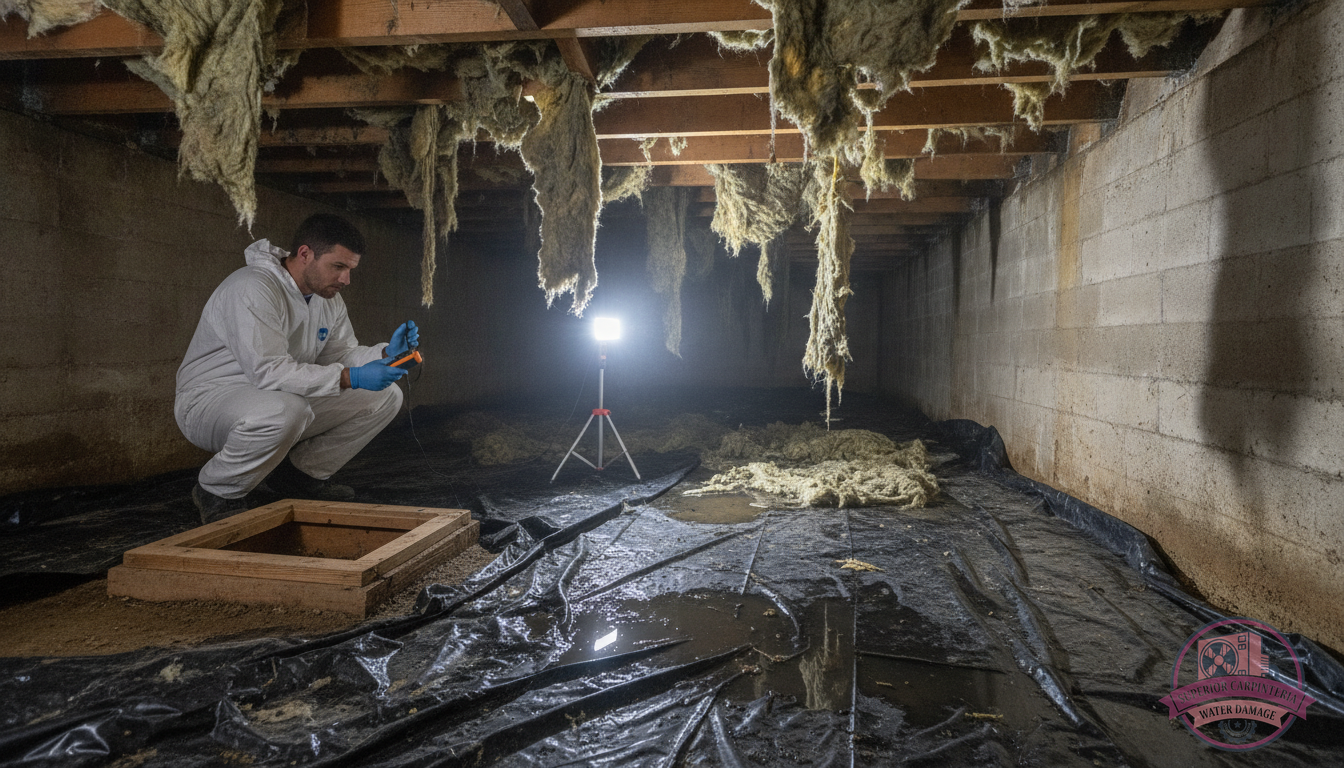
- Inspection and moisture mapping: We use pin-type moisture meters on wood framing surfaces and borescope cameras where access is limited to document baseline moisture levels and identify the full scope of damage before any work begins.
- Removal of damaged insulation: Saturated fiberglass batt insulation has lost its thermal value, cannot be dried effectively in place, and provides an ideal substrate for mold growth. We remove and double-bag contaminated insulation for proper disposal.
- Antimicrobial treatment: Affected wood surfaces — joists, rim joists, blocking, and subfloor sheathing — are treated with EPA-registered antimicrobial solution to eliminate existing mold colonies and inhibit future growth.
- Structural drying: Industrial air movers and low-grain refrigerant dehumidifiers are positioned throughout the crawl space to dry the structural wood assembly to IICRC-standard moisture levels. Daily moisture readings verify progress. For more detail on this phase, see our structural drying service page.
- Vapor barrier installation: Once drying is verified, we install a reinforced polyethylene vapor barrier — typically 12 to 20 mil thickness — across the entire crawl space floor and lap it up the foundation walls. Seams are overlapped and taped, and penetrations around pipes and posts are sealed to create a continuous moisture control system.
Vapor Barrier vs. Full Encapsulation: Which Does Your Carpinteria Home Need?
A basic vapor barrier is a thin polyethylene sheet laid loosely on the crawl space floor. It reduces some moisture evaporation from the soil but does not seal wall surfaces, penetrations, or vents. In a lower-humidity inland environment, a basic barrier may be adequate.
In coastal Carpinteria, full encapsulation is almost always the better investment. A reinforced liner sealed to foundation walls and all penetrations dramatically reduces ambient humidity in the crawl space — often dropping relative humidity from 80–90% to well below 60% — which protects framing, discourages mold, and can even improve indoor air quality in the living areas above. The performance difference in a coastal environment is significant.
When Crawl Space Mold Is Already Present
If our inspection reveals active mold colonies on joist or subfloor surfaces — which is common in crawl spaces that have had elevated moisture for more than a few weeks — our team can integrate full mold remediation into the project without requiring a separate contractor mobilization. Containment, HEPA air scrubbing, surface treatment, and encapsulation are completed in a single coordinated scope of work, minimizing disruption and project timeline.
Protecting Your Carpinteria Home From the Ground Up
Superior Carpinteria Water Damage serves homeowners throughout Carpinteria, La Conchita, Eastside Santa Barbara, and the broader Santa Barbara County coast. Our team is available Monday through Sunday, 8 AM to 6 PM, for crawl space inspections, emergency water extraction, structural drying, and mold remediation. Call (820) 444-6782 or email [email protected] to schedule an inspection.
Need Service?
Call +18204446782 or fill out our online form for a free, no-obligation quote.
Request Free Quote