Carpinteria's Coastal Climate and Your Home's Mold Risk
Carpinteria is one of the most beautiful places on the California coast — and one of the most challenging environments for indoor moisture control. Sitting directly on the Pacific, the city experiences persistently elevated ambient relative humidity, frequent marine layer mornings, and mild temperatures year-round. While those conditions make Carpinteria a wonderful place to live, they also create exactly the environment mold needs to thrive: consistent moisture, moderate warmth, and an abundance of organic building materials to colonize.
When water intrusion occurs — whether from a plumbing failure, roof leak, or storm flooding — mold colonization can begin on damp surfaces in as little as 24 to 48 hours. In a lower-humidity inland climate, a slow-drying wall cavity might remain below the threshold for mold growth for several days. In coastal Carpinteria, that same cavity may support active mold colonies within two days because the surrounding air is already carrying significant moisture load, slowing evaporation and keeping material moisture content elevated.
What Mold Actually Needs to Grow in Your Home
Understanding mold's requirements helps explain why Carpinteria properties are particularly vulnerable:
- Moisture: Mold requires a water activity level above roughly 0.70 — meaning it does not need standing water, only materials that remain damp. Coastal humidity keeps many porous building materials closer to that threshold even without a direct water event.
- A food source: Drywall paper, wood framing, insulation batts, and carpet backing are all organic materials that mold consumes readily.
- Moderate temperature: Carpinteria's mild year-round temperatures fall squarely in the 40°F–100°F range where most mold species grow aggressively.
- Time: Without professional intervention, a damp wall cavity can transition from a drying problem to an active mold colony in less than 48 hours.
Hidden Moisture: The Threat You Can't See
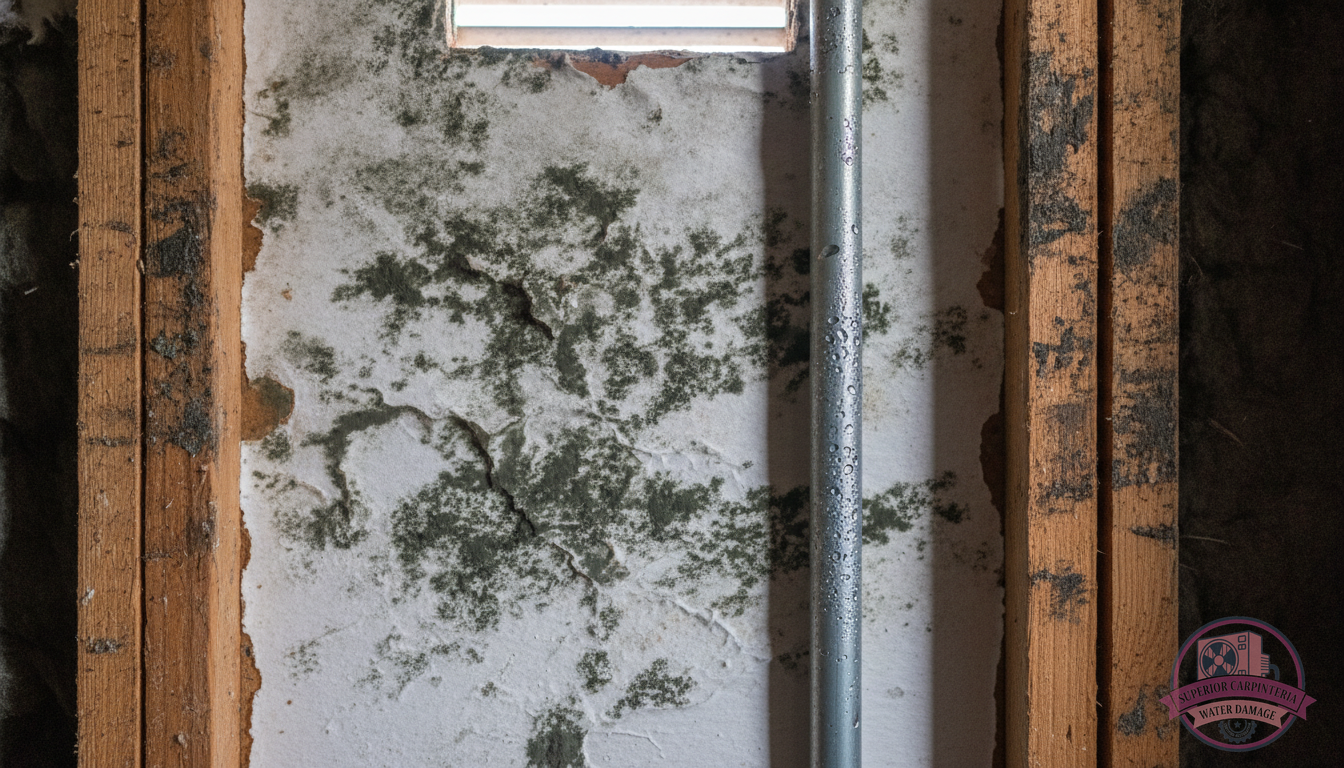
One of the most dangerous aspects of mold growth in Carpinteria homes is that it frequently begins in places invisible to the naked eye. Wall cavities behind drywall, the underside of subfloor sheathing, crawl space joist surfaces, and the interiors of HVAC ducts are all common mold colonization sites that homeowners never see until the problem has progressed significantly. By the time a musty odor becomes noticeable in living areas, mold growth behind walls may be extensive.
This is why our water damage restoration process includes thermal imaging camera inspection and pin-type moisture meter readings in every affected material category — not just visual inspection of visible surfaces. Hidden moisture identified early can be dried in place. Hidden moisture discovered weeks later often means demolition, mold remediation, and full reconstruction.
What Professional Mold Remediation Involves
When mold is discovered — either during the drying process or during a separate inspection — professional mold remediation follows a specific sequence of steps designed to remove mold safely without spreading spores to unaffected areas of your home:
- Containment: Polyethylene sheeting is sealed over doorways and HVAC vents to create a negative pressure containment zone around the work area. Commercial air scrubbers with HEPA filtration run continuously to capture airborne spores before they can migrate.
- Removal of contaminated materials: Mold-saturated drywall, insulation, and other porous materials that cannot be effectively cleaned are carefully removed, double-bagged, and disposed of according to California guidelines.
- Surface treatment: Salvageable hard surfaces such as exposed framing lumber are wire-brushed and treated with EPA-registered antimicrobial agents to eliminate residual mold.
- HEPA vacuuming: Every surface within the containment zone is HEPA-vacuumed before a final antimicrobial application.
- Clearance verification: We conduct a visual clearance inspection upon completion and can coordinate independent post-remediation verification testing with a third-party industrial hygienist if required by your insurance carrier or lender.
Crawl Spaces: Carpinteria's Hidden Mold Hotspot
In Carpinteria and surrounding coastal communities like Summerland and Rincon Point, crawl spaces are among the most common sites for advanced mold colonization. The combination of groundwater seepage, condensation from humid Pacific air, and poor ventilation creates ideal conditions for mold to consume floor joists, rim joists, and insulation batts entirely out of sight. Our crawl space drying and encapsulation service addresses existing moisture damage and installs a reinforced vapor barrier system to prevent recurrence — dramatically reducing the ambient humidity that feeds mold growth in the space above your foundation.
Does Mold Affect Your Health?
Many mold species produce allergens, irritants, and in some cases mycotoxins that cause respiratory symptoms, skin irritation, headaches, and allergic reactions. Children, elderly individuals, and people with asthma or compromised immune systems are particularly susceptible. If household members are experiencing unexplained respiratory symptoms and you have had any recent water intrusion — even a minor one — a professional moisture inspection is a prudent step.
Mold Remediation for Carpinteria and Nearby Communities
Superior Carpinteria Water Damage provides professional mold remediation throughout Carpinteria, Montecito, La Conchita, Eastside Santa Barbara, and the surrounding Santa Barbara County coast. We are available Monday through Sunday, 8 AM to 6 PM. Call us at (820) 444-6782 to schedule an inspection or to reach our team during an active moisture emergency.
Need Service?
Call +18204446782 or fill out our online form for a free, no-obligation quote.
Request Free Quote